

01 / 03 · A crowded market
Everyone sounds the same
Thousands of software-testing companies promise better quality, faster releases and lower costs. To the buyer, their messages can be difficult to tell apart.
Software-testing companies compete in a crowded market where nearly everyone promises better quality, faster releases and lower costs. The Automation Architecture Analyzer shows how a diagnostic can turn specialized expertise into something more valuable: evidence of a problem worth discussing.
Thousands of software-testing companies promise better quality, faster releases and lower costs. To the buyer, their messages can be difficult to tell apart.
A real finding from a public automation repository
Instead of sending another capabilities pitch, the salesperson shares a real diagnostic example.

The prospect explores an actual repository analysis and sees what the diagnostic can reveal, without being asked to accept a hypothetical claim.
The salesperson can share the same diagnostic through email, LinkedIn, the company website, trade shows or live sales conversations — a reusable engagement capability.
The Automation Architecture Analyzer uses real public-repository evidence. The seller and prospect journey illustrates how the diagnostic can be used.
The message is no longer “Here’s what we do.” It becomes “Here’s something worth examining.”
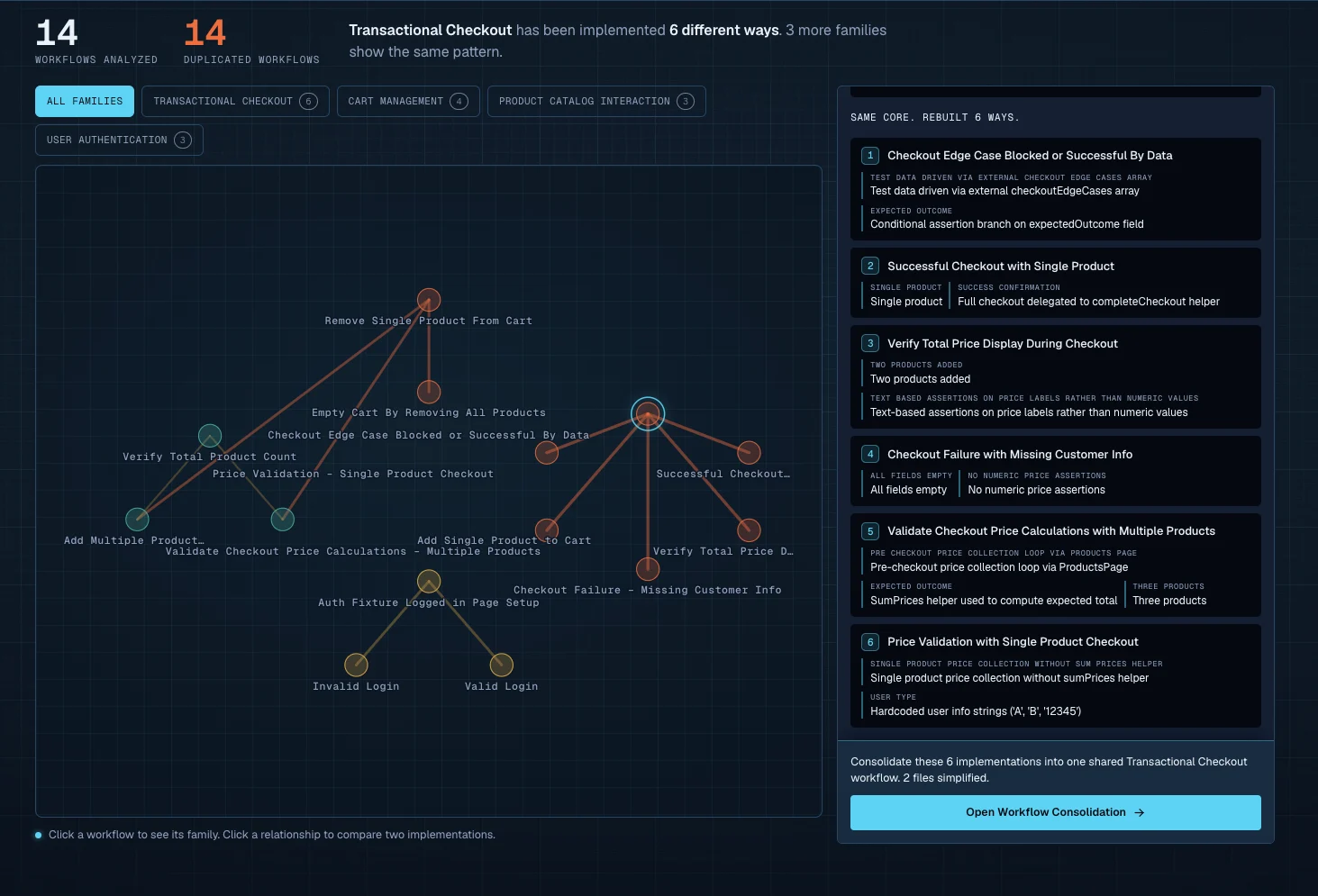
The same checkout workflow had been built six separate times, and three more families showed the same pattern.
The Automation Architecture Analyzer applies automation-maintainability expertise to repository evidence, revealing where one workflow change can multiply across the test architecture.
The same checkout workflow, built six separate ways.
 Enlarge
Several implementations of the same checkout workflow appear across multiple files.
Shared workflow logic has no central control point.
One checkout change may require coordinated updates across multiple files. A missed update can create conflicting test results, additional investigation and release delays.
Centralize the shared workflow spine while preserving scenario-specific behavior.
Software companies use automated tests to make sure important customer experiences — such as logging in, placing an order or processing a payment — keep working whenever the product changes.
Over time, different people may build slightly different versions of the same test workflow across multiple files. Everything can appear to work until the underlying business process changes.
It is like keeping six separate instruction manuals for the same procedure. Every change has to be found and correctly updated in every copy.
A single product change can require coordinated updates across many tests, files and teams.
Engineers spend more time finding, updating and repairing automation instead of improving the product.
Teams may struggle to tell whether a failure comes from the product or from outdated automation.
Extra investigation and repair work can delay releases and increase operating risk.
The Automation Architecture Analyzer reveals where structural maintenance risk is building up before the automation becomes too expensive and disruptive to untangle.
Finding a handful of duplicated implementations across a few files does not prove that the entire repository has the same problem. But it raises an important question:
How many more duplicated workflows exist across the tests that were not examined?
In a large automation suite, similar patterns may have been repeated by different people over many years. As the architecture becomes more fragmented:
Eventually, an automation suite can become so difficult to maintain that repairing it piece by piece is no longer practical. Some organizations reach the point where they must substantially rebuild or replace large parts of the suite, losing much of the time and investment that went into it.
The initial finding does not claim to prove a repository-wide problem. It creates a credible reason to find out whether the pattern is isolated or systemic.
A real example creates curiosity. The prospect's own evidence reveals whether the problem exists in their environment.

The GitHub example turns an abstract technical risk into a recognizable business concern.

The prospect provides selected automation files so the same diagnostic can be applied to their environment.

The sample reveals whether similar workflow duplication exists and raises the question of how far the pattern may extend.
Only a subset examined
The salesperson and prospect review the evidence, the business impact and the next investigation together.
The Automation Architecture Analyzer uses real public-repository evidence. The seller and prospect journey illustrates how the diagnostic can be used.
The meeting is no longer about testing services. It is about whether the architecture is becoming too costly to maintain.
The company's experts understand how scalable automation should separate reusable workflows from scenario-specific behavior.
The Automation Architecture Analyzer examines actual automation files rather than relying on generic assumptions.
The diagnostic reveals where fragmented workflow architecture may be increasing maintenance risk.
The salesperson and prospect can decide whether the finding is isolated, widespread and worth addressing.
The Automation Architecture Analyzer is one specialized diagnostic. A company may eventually use several diagnostics to examine different problems its experts are qualified to recognize.
Meetworthy turns specialized company knowledge into diagnostic experiences that uncover something useful before the sales conversation, or give the prospect a compelling reason to begin one.